You've heard the term "Oral Placement Therapy" or "TalkTools" from your child's speech therapist, but what does it actually mean? If your child can understand language perfectly well but struggles to produce clear speech sounds, the issue might not be in their brain's language centre — it might be in the muscles of their mouth. Oral Placement Therapy (OPT) is a specialised approach that trains these muscles to work properly for speech. Here's what you need to know, explained without the clinical jargon.
The Basic Idea
Speaking requires incredibly precise muscle coordination. Your tongue must move to exactly the right position, your lips must shape correctly, your jaw must open to a specific degree, and your soft palate must close off the nasal passage — all within milliseconds. For some children, these muscles are weak, uncoordinated, or not getting the right sensory feedback.
Traditional speech therapy teaches children what sound to make ("say sss, not th"). OPT teaches the muscles how to physically produce that sound. It's the difference between telling someone to throw a ball accurately versus training their arm muscles to do it.
Who Developed OPT?
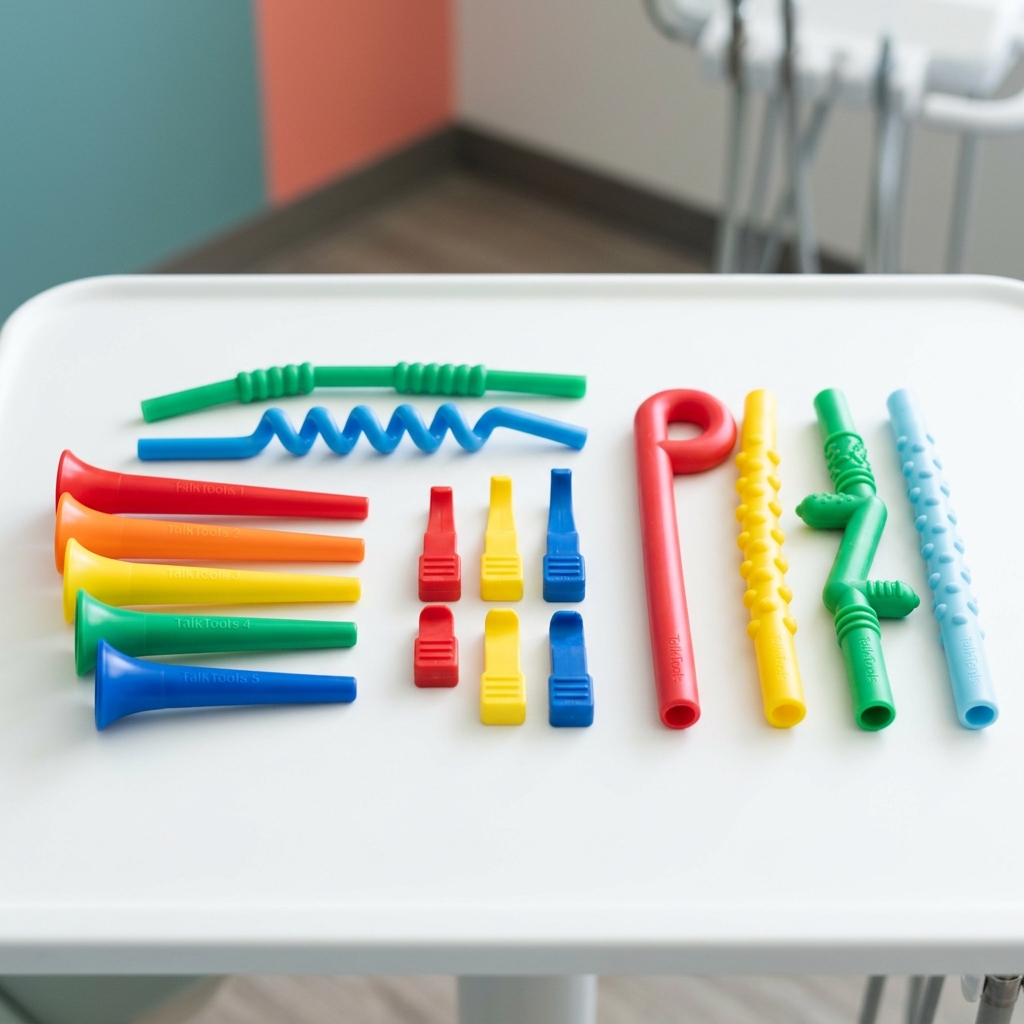
Oral Placement Therapy was developed by Sara Rosenfeld-Johnson, a speech-language pathologist in the United States. She created the TalkTools system — a structured hierarchy of therapeutic tools and exercises that systematically build jaw stability, lip closure, tongue elevation, and airflow control. The TalkTools methodology is now taught internationally and used by thousands of certified therapists.
Who Benefits From OPT?
OPT is particularly effective for children with:
- Down syndrome: Low oral-muscle tone often affects speech clarity significantly
- Childhood apraxia of speech (CAS): Difficulty planning and coordinating the movements needed for speech
- Cerebral palsy: Motor impairments affecting the speech musculature
- Autism with oral-motor involvement: Some children on the spectrum have concurrent oral-motor weakness
- Structural differences: Post-surgical cleft palate repair, dental malocclusion
- Persistent articulation errors: Children who haven't responded to traditional articulation therapy alone
- Feeding difficulties: Drooling, difficulty chewing, messy eating, or food pocketing
Key Distinction: OPT is not appropriate for every child with a speech delay. If your child's difficulty is primarily with language (finding and organising words) rather than motor execution (physically producing sounds), standard speech-language therapy is the right approach. A qualified SLP can determine which your child needs.
The Three Pillars of OPT
1. Jaw Stability and Grading
The jaw is the foundation of all speech movement. Without a stable jaw, the tongue and lips can't move independently and precisely. OPT uses a hierarchy of bite blocks and chewing exercises to train the jaw to:
- Open to specific, controlled heights (different vowels require different jaw positions)
- Stabilise while the tongue and lips move independently
- Grade movement — moving smoothly between open and closed positions
2. Lip Closure and Rounding
Lips need to close for sounds like /m/, /b/, /p/ and round for sounds like /w/, /oo/, /oh/. OPT trains lip function through:
- Horn hierarchy: A series of horns requiring progressively more lip rounding and airflow control
- Straw hierarchy: Drinking through straws of decreasing diameter to build lip closure strength
- Bubble-blowing and sustained airflow activities
3. Tongue Elevation and Lateralisation
The tongue is the most mobile muscle involved in speech. It needs to move up, down, forward, backward, and side-to-side with precision. OPT exercises include:
- Tongue tip elevation exercises for sounds like /t/, /d/, /n/, /l/
- Tongue retraction for back sounds like /k/, /g/
- Lateralisation (side-to-side movement) for chewing and some speech sounds
- Independence from jaw movement — the tongue must move without the jaw compensating
What Does an OPT Session Look Like?
A typical 45–60 minute OPT session at our clinic involves:
- Warm-up: Oral-motor exercises to activate muscle groups (5–10 minutes)
- Tool-based exercises: Working through the current level of the horn, straw, or bite block hierarchy (15–20 minutes)
- Sound practice: Transferring the new muscle skill to actual speech sounds, syllables, words, and sentences (15–20 minutes)
- Home program review: Teaching parents the exercises to practise daily at home (5–10 minutes)
How Long Does OPT Take to Show Results?
Results depend on the child's diagnosis, severity, and consistency of home practice:
- Jaw stability improvements: Often visible within 4–6 weeks of consistent practice
- Lip and tongue function: Measurable gains typically appear within 2–3 months
- Speech clarity improvements: Noticeable changes in intelligibility usually begin around month 3–4, with continued improvement over 6–12 months
Home practice is non-negotiable. OPT exercises must be done daily — typically 10–15 minutes — for the muscle training to be effective. A child who only practises during weekly therapy sessions will progress very slowly.
OPT vs Traditional Articulation Therapy
| Aspect | Traditional Articulation | Oral Placement Therapy |
|---|---|---|
| Approach | Auditory — "listen and repeat" | Tactile — "feel how the muscles move" |
| Best for | Children with good oral-motor function | Children with weak or uncoordinated oral muscles |
| Tools | Mirrors, flashcards, repetition | Horns, straws, bite blocks, chewy tubes |
| Focus | Sound-level accuracy | Muscle-level preparation + sound accuracy |
| Home practice | Speech drills and word lists | Daily oral-motor exercises + speech practice |
In practice, many clinicians — including our team at Rapture — use both approaches together. OPT builds the muscular foundation; traditional therapy builds the sound repertoire on top of it.
OPT at Rapture Therapy Centre
Our speech-language pathologists at Rapture Therapy Centre in Rajarajeshwari Nagar, Bangalore are trained in the TalkTools OPT methodology. We use the full hierarchy of certified TalkTools equipment and combine OPT with evidence-based articulation and language therapy for a comprehensive approach to speech clarity.
Is OPT Right for Your Child?
If your child's speech remains unclear despite traditional therapy, or if they've been diagnosed with oral-motor weakness, Oral Placement Therapy may be the missing piece. Book an oral-motor assessment to find out.
Book an Oral-Motor Assessment